

Solar Halos – Defining The "Rings" Around The Sun
Solar Halos – Defining The "Rings" Around The Sun

Occasionally, when looking up at the sky, you may notice a hazy rainbow-coloured ring around the sun. This phenomenon is better known as a solar or 22-degree halo, but what is this occurrence?
These optical phenomena can occur quite frequently and are not an unfamiliar sight, yet very few people really know what exactly they are or how they are formed.
This article examines what these rings (or solar halos) are and how they are created. It also looks at its characteristics and the conditions surrounding it.
What Is A Solar Halo?
The introduction provided a brief description of what this spectacular-looking meteorological phenomenon around the sun is. To better understand its formation, though, we first need a more detailed definition.
Defining A Solar Halo
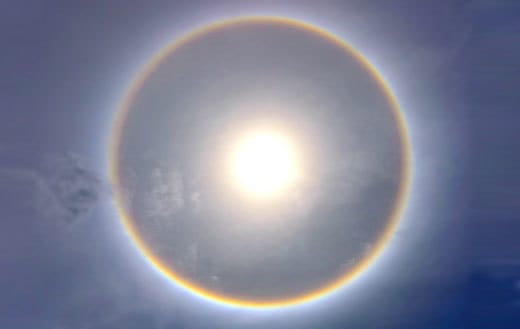
Rings (or halos) around the sun are the result of sunlight being refracted by millions of ice crystals present in cirrus clouds drifting at a height of 6000 meters (20 000 feet) or more above the earth’s surface.
The hazy rings appear at a radius of approximately 22 degrees around the sun, and are characterized by varying degrees of rainbow colors and an undefined, fuzzy border.
It occurs in the upper troposphere, where temperatures are too low for water to remain in its liquid form. The hexagonal shape of the ice crystals breaks the sunlight up and redirects it back to Earth.
A solar halo goes by many different names. Sometimes it is simply referred to as “the ring around the sun” or “sun halo.” The scientific community refers to it as a 22° halo, and its formation is similar to that of other halos, such as the rare 46° halo.
The color of a solar halo varies from a faint rainbow color to a pale white tint. The rainbow colors are the result of the ice crystals breaking up the white light into its primary colors. Sometimes, though, the primary colors combine and blend together to form a white tint.
(The hue and intensity of the color largely depend on the strength of the sunlight, the density of the clouds, and the angle of refraction.)
The halo is not visible to everyone when the sun shines through Cirrus clouds. It depends on your physical location in relation to the position of the sun. Depending on your position, the ice crystals refract the light from the sun at just the right angle for the halo to be visible.
A solar halo is the same phenomenon you can see around the moon at night. The halo you see around the moon is the same meteorological effect. Instead of sunlight, though, it is the moonlight that is refracted in this case.
What Causes The Ring Around The Sun


Illustration showing how sunlight is refracted by ice crystals in high cirrus clouds, creating a 22° halo around the sun as seen by an observer on the ground
As mentioned, the rings you see around the sun result from the ice crystals in cirrus clouds refracting the light in such a way that you can see a ring appearing from your location on the planet’s surface.
A few things need to be in place in order to observe these rings surrounding the sun clearly.
1. The presence of the sun in a mostly clear sky.
2. A clear sky with only a thin layer of cirrus clouds high up in the atmosphere is essential. (Thicker clouds present lower down in the atmosphere will obscure or eliminate the effect.)
3. As the light from the sun hits the cirrus clouds, it gets refracted or “bent” by the ice crystals. The refraction by the ice crystals causes the light to be projected in a different direction.
4. If the light is refracted or “bent” at a certain angle, specifically 22 degrees, the rings will become visible to the observer. (This also means the rings have a radius of about 22 degrees around the sun.) That is why this occurrence is also referred to as a 22° halo by scientists and meteorologists.
As already mentioned, an individual also has to be in the right geographical location on the planet’s surface (in relation to the sun’s location) to observe this phenomenon.
Characteristics Of The Rings Around The Sun
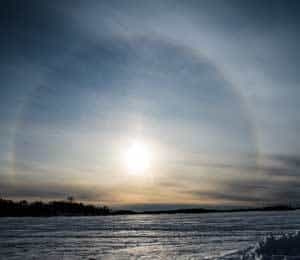
The ring around the sun has a mostly rainbow-colored hue but can also display a pale white color as a result of primary colors overlapping and blending together. This is a direct result of the hexagonal shape of the ice crystals.
Like the shape of raindrops causing the different colors in a rainbow to appear, the faceted (hexagonal) shape of ice crystals refracts the sunlight and breaks it up into its primary colors.
This is why you will occasionally notice that some rings around the sun have a red tint on the inside and a blue tint on the outside.
As the sun is much brighter than the moon, the rings around the sun not only display a rainbow-colored hue but also appear much brighter and clearly defined due to the increased luminescence.
What is also very noticeable is that the sky between the edge of the sun and the halo always appears darker than the rest of the sky.
On rare occasions, one may also catch a glimpse of not one but a double halo surrounding the sun.
Superstitions Surrounding The Halo Around The Sun
Over centuries, many cultures worldwide believed a ring around the sun was a sign that rainy weather was on the way. This is neither a myth nor a superstition. The presence of high cirrus clouds is very often an indication of wet and stormy weather approaching.
Cirrus clouds normally precede low-pressure systems by a day or two, and as many of you may already know, low-pressure systems are at the heart of stormy wet weather. (You can read more about low-pressure systems and cold fronts in this article.)
During biblical times, the rainbow was used as a sign from God as evidence of His covenant with Noah to never flood the Earth again. The rainbow-colored halo around the sun has been given the same symbolic meaning as the traditional rainbow.
In African mythology, a solar halo is seen as a sign of great change ahead. (They also believe that it signals the arrival of rain, which is more in line with scientific evidence.)
Conclusion
As illustrated, the multicolored ring around the sun that sometimes occurs under ideal conditions is not nearly as mysterious or uncommon as one might think.
There is a very logical and scientific explanation for its occurrence, which has everything to do with what is going on in our atmosphere, and nothing to do with what is happening in space around the sun itself.
It is also worth mentioning again that the halo one sometimes observes around the moon is also exactly the phenomenon that occurs around the sun.
Until next time, keep your eye on the weather!