

Defining Precipitation – What It Is And How It Occurs
Defining Precipitation – What It Is And How It Occurs
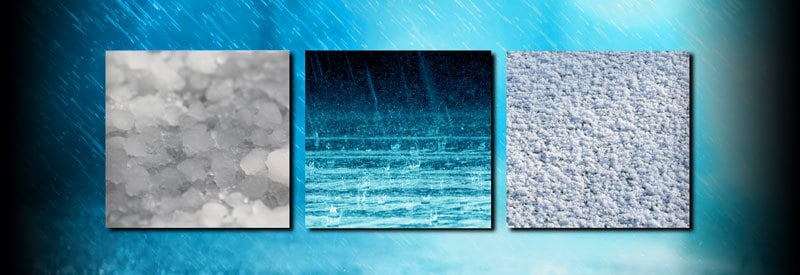
When you hear the word precipitation, one normally tends to think about rainfall, or water in its liquid state. In truth, precipitation is the umbrella term for several meteorological events like rain, snow, and hail.
In short, precipitation is nothing more than water in some of its states that falls to the ground as a result of gravity. It is one of the most crucial elements of weather and climate and is essential for all life on Earth.
No matter what form it takes, once water particles grow and become too heavy to stay suspended in the air, gravity takes over, and they start falling to the ground.
In this post, we examine what precipitation is, the different forms of this occurrence, and how it is formed.
What Is Precipitation?
From the introduction alone, one should already have a pretty good idea of what precipitation is. But before delving into the details of how it forms and the different types, one needs a clear and concise definition of what exactly precipitation is.
Precipitation Definition
Precipitation is defined as water falling to the planet’s surface in its liquid or solid state as a result of gravity. Water droplets or ice crystals that form due to condensation or sublimation in the air collide, merge, and become too heavy to stay airborne and fall to the ground.
As will soon be illustrated, all types of precipitation form in the same way, with only a few variables making the difference. And it’s mostly the type of environment (clouds), temperature, and winds that determine the type of precipitation that will reach the ground.
How Precipitation Forms
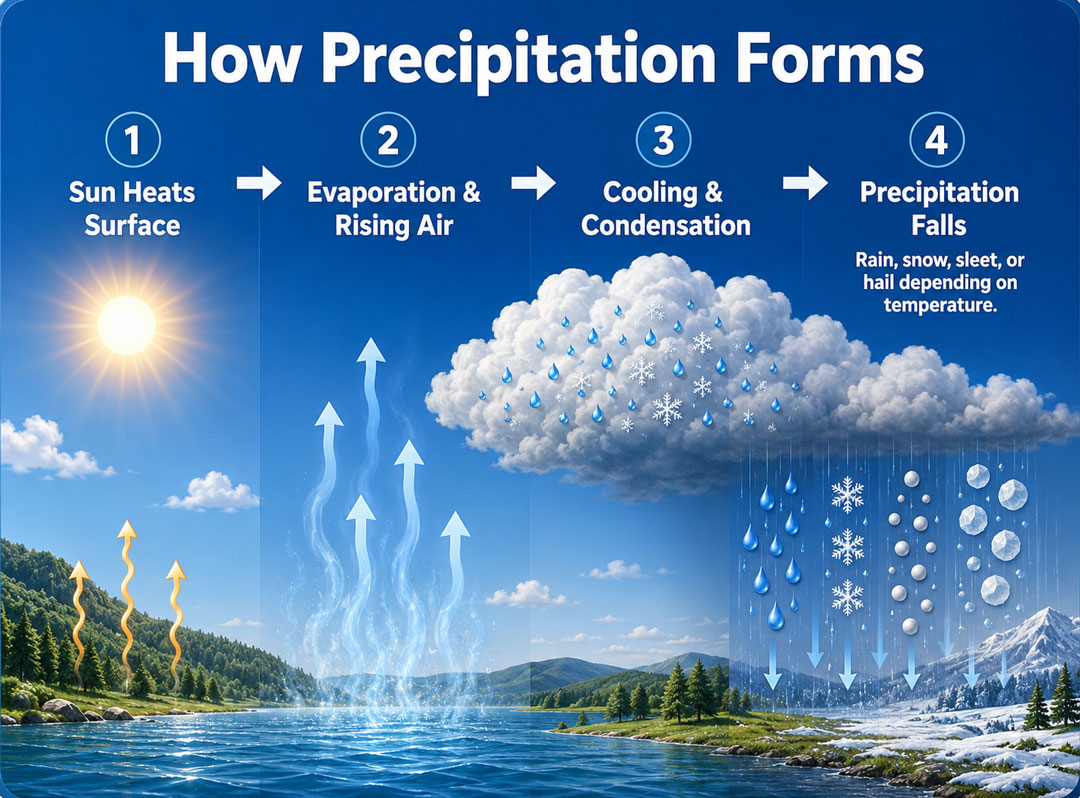
Diagram illustrating how precipitation forms. Click on the image for a larger view.
Precipitation is mainly the result of evaporation and condensation. The form of precipitation can vary according to the different variables present. Without these two processes, though, it will not be possible for any precipitation to form at all.
There is more than one way for precipitation to take place, but one of the most common ways is also the best way to explain the process.
As the Sun heats the surface of the Earth, over land or water, it also warms up the air directly above it. Since warm air is lighter than cold air, it starts to rise into the atmosphere as it expands.
The heat also causes moisture on the ground and surface water to evaporate, adding to the water vapor already present in the air.
Since air temperature drops with altitude, the rising warm air starts to cool down. Once it cools down to the point where the water can no longer stay in its gaseous form, condensation takes place, and small water droplets form.
The tiny water droplets collide and merge with each other until they become too heavy to stay suspended in the air. As a result, precipitation takes place in the state dictated by the surrounding atmospheric conditions and variables.
There is a multitude of ways for evaporation and condensation to take place, but they are all based on the key principles described in this section.
Types Of Precipitation
-
- Rain
- Freezing Rain
- Snow
- Graupel (Snow Pellets)
- Snow Grains
- Hail
- Sleet (Ice Pellets)
- Ice Crystals (Diamond Dust)
By looking at each form of precipitation in more detail, you will also realize that the most significant difference between them is the manner in which they are formed.
1) Rain
Rain is the most common form of precipitation that occurs across the world and is the most significant contributor to the water cycle. Before we can examine how it forms and what its characteristics are, we first need to define what exactly rain is:
Rain Definition
Rain is water in its liquid state. When condensation takes place in temperatures above freezing point, water vapor in the atmosphere turns from its gaseous state back into its liquid state. Small water droplets form as a result.
As the small water droplets bump into each other, combine, and grow in size, they become too heavy to stay suspended in the air and fall to the ground as a result of gravity.
Some classification systems make a distinction between rain and drizzle. It is unnecessary since the only difference is the size of the raindrop. If it has a diameter of 0.5 mm (0.0197 inches) or less, it is classified as a drizzle. Any larger and the drop gets classified as rain.
A misconception exists about the shape of a raindrop. Most people view the teardrop shape as the shape of a drop of rain. It is not the real shape of a raindrop at all. Learn more about the true form of raindrops and why they get confused with the teardrop shape in this article.
2) Freezing Rain
Freezing rain very seldom starts as supercooled water drops. It is usually rain or snow that melts before encountering a much colder layer of air. To define what freezing rain is:
Freezing Rain Definition
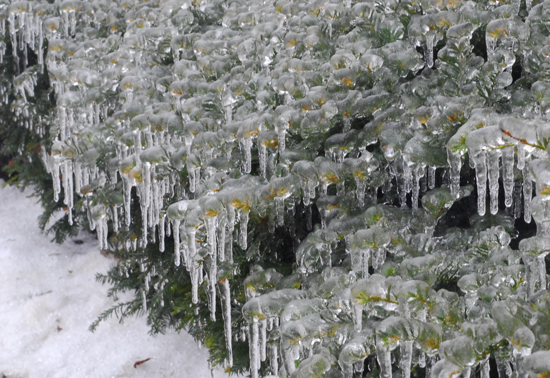
Freezing Rain forms when raindrops get supercooled as they travel through a layer of air with subzero temperatures. The resulting icy droplets immediately freeze when they come in contact with objects on the ground.
Since it creates a uniform layer of ice on the objects and surface of the ground, freezing rain can create hazardous conditions. The relatively thin, smooth layer of ice is almost invisible to the naked eye.
These slippery conditions can be lethal for road goers, as it is easy to lose control and slide on the smooth surface. It has already led to numerous road accidents in the past. Pedestrians can also suffer serious injury when walking and slipping on the ice-coated ground.
3) Snow
Subzero conditions and enough water vapor in the atmosphere are two of the most important ingredients necessary for the formation of snow. But what is snow?
Snow Definition
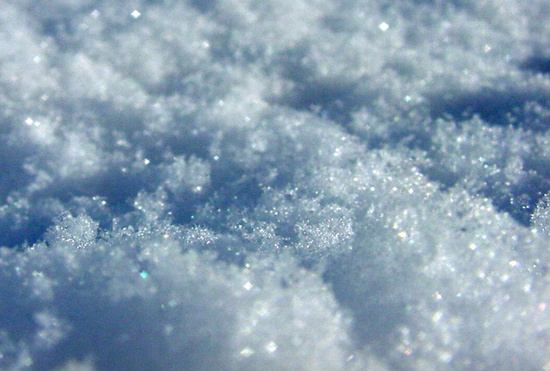
Snow is a collection of ice crystals that form around pollen or dust particles when water vapor condenses around them in sub-zero temperatures (below 32° Fahrenheit or 0° Celsius). When the ice crystals collide with each other, they cling together and grow in size. When enough ice crystals join together, they form a snowflake.
As more crystals and other snowflakes get added to the main snowflake, it grows in size and weight. When it becomes too heavy, it starts to fall to the ground due to the Earth’s gravity.
Snowflakes have a light and soft physical nature as they are made up of a collection of ice crystals and can easily lose their shape or get crushed on the ground.
Under perfect conditions, it has the hexagonal (six-sided) shape most people associate with a snowflake. In real-world situations, though, this very seldom happens.
4) Graupel
Also known as snow pellets, graupel is an interesting form of precipitation. It is neither a solid hailstone nor a snowflake but rather a combination of both. The way it is formed has everything to do with its unique characteristics.
Graupel Definition
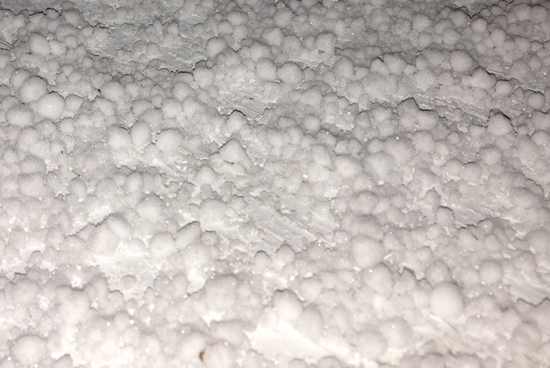
Graupel is formed when snow falls through an area of supercooled water. Upon contact, the water freezes around the snowflake and rimes it, resulting in the formation of graupel.
Graupel cannot be classified as a form of hail or ice pellet, as it does not consist of solid ice or layers of ice. Instead, it is lighter and more fragile as a result of the snowflake structure inside the layer of rime.
On the ground, it creates a layer of unstable ice that can easily be crushed or deformed. Learn more about graupel and how it differs from snow and hail in this article.
5) Snow Grains
As the name suggests, snow grains are very small pieces of ice. This almost invisible type of precipitation can be defined as follows:
Snow Grains Definition
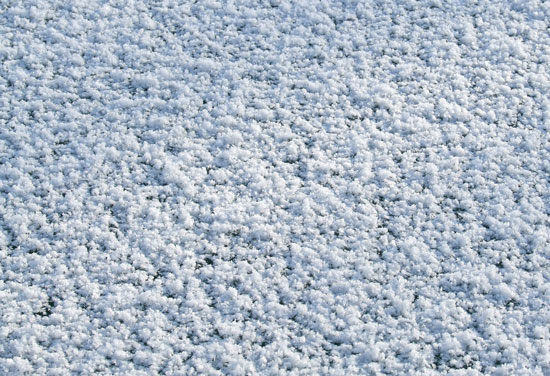
Snow grains are small flat pieces of solid ice, usually less than 1 millimeter in diameter. They typically fall from stratus clouds or fog and in small numbers at a time.
Due to their small size and the fact that they never fall in the form of a shower, they are often seen as the frozen equivalent of drizzle.
6) Hail
Hail is probably the most well-known type of precipitation that consists of solid ice. Not many observers are aware of how these sometimes golfball-sized balls of ice are formed:
Hail Definition
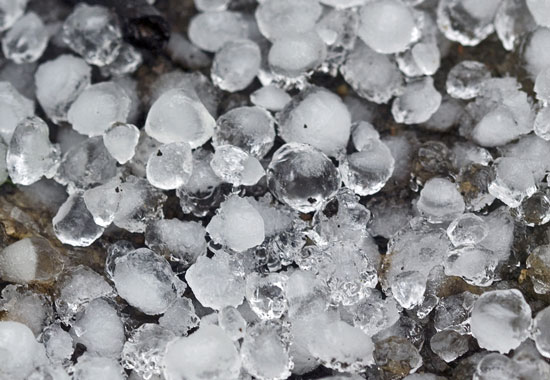
Hail is solid layered balls of ice that form as water droplets are carried up high in the atmosphere through updrafts in storm systems. At these altitudes, they are exposed to temperatures below freezing point, causing them to freeze into hailstones. Updrafts keep carrying the hailstones up into freezing air, adding a layer of ice each time until they become too heavy and fall to the ground.
Hail commonly occurs in clouds with a large vertical buildup, like cumulonimbus clouds and supercells, where strong updrafts are present. Hailstones also vary in size from only a few millimeters to the size of tennis balls.
Depending on the size of the hailstones, a hailstorm can be devastating and cause extensive damage to infrastructure, vegetation, and transport. It can also cause injury and, in some cases, be fatal to humans and animals.
7) Sleet
Also known as ice pellets, sleet is often confused with hail. Although there may be similarities in appearance, sleet is different in structure and the way it forms.
Sleet Definition
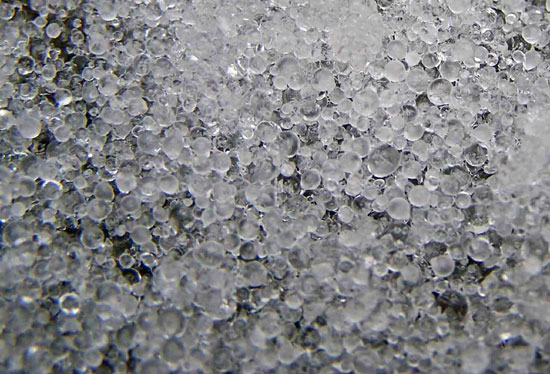
Sleet is the small ice pellets that form when snow or other frozen precipitation falls through a layer of warm air. It melts into a liquid form before falling through another layer of air with subzero temperatures, which causes it to freeze again and form small pellets of ice.
Since it is much smaller than hail, it does not pose any significant threat to infrastructure, vegetation, and transport. It does, however, result in slippery conditions on surfaces like roads, which motorists often underestimate.
Learn more about sleet and the difference between sleet and freezing rain in this article.
8) Diamond Dust
Diamond dust is also known as ice crystals or ice needles and, as the name suggests, is very small in size. (Basically, the same size as drizzle.)
Diamond Dust Definition
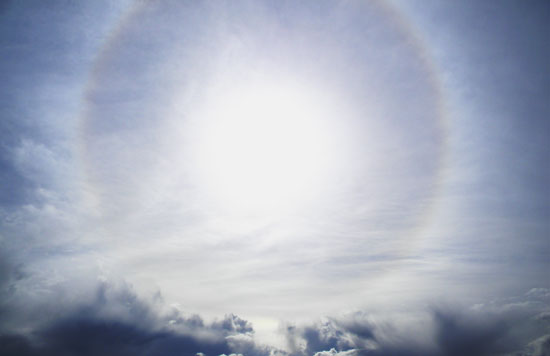
Diamond Dust is tiny ice crystals that form close to the ground and at temperatures below -30° Celsius (-22° Fahrenheit). It has the physical appearance of a low-lying transparent cloud.
This almost microscopic-sized form of precipitation gets its name from the sparkling effect of the Sun’s light reflecting off the ice crystals.
Conclusion
As you can clearly see, precipitation comes in many forms. From solid ice to light drizzle and everything in between, the impact on the environment and the conditions it creates can also vary widely.
In this post, we defined precipitation, listed the most common forms it can take, and described their formation and characteristics.
Until next time, keep your eye on the weather!