

What The Percentage Chance Of Rain Actually Means In Weather Forecasts
What The Percentage Chance Of Rain Actually Means In Weather Forecasts
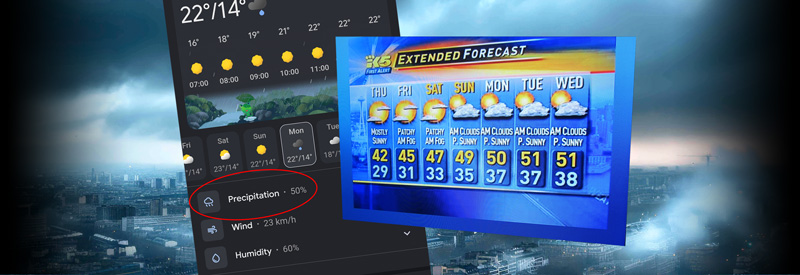
Whenever you watch a weather forecast or look at your favorite weather app, you will be very familiar with the term “chance of rain,” typically expressed in percentages. It may sound simple, but it is an often-misunderstood term.
When figures like a 10% or 75% chance of rain are mentioned during forecasts, for many viewers, it is not always clear what exactly this number means. This often results in incorrect interpretations and can even lead to complete misconceptions.
Since this percentage figure alone does not clarify whether it refers to a specific period of time or a certain part of a region, it is easy to understand how confusing it can be.
The percentage chance of rain is also known as Probability of Precipitation (or PoP), which is commonly used by meteorologists. As the latter is more representative of the term and its meaning, we will use Probability of Precipitation for the remainder of this article.
In the upcoming sections, we will look at exactly what Probability of Precipitation is, how it is calculated, common misconceptions surrounding it, and the important takeaways for you.
What Does Probability of Precipitation Mean?
Before we delve deeper into what Probability of Precipitation means and how it is calculated, one first needs a clear and concise definition of what exactly it is:
Probability of Precipitation Definition

The percentage chance of rain, or Probability of Precipitation, can be defined as the statistical probability of precipitation occurring at a specific location within a region during a specified period of time, typically expressed as a percentage.
To get a better understanding of what this definition means in practice, one needs to clarify the amount of rainfall meteorologists consider as precipitation. Most professional weather services consider a minimum of 0.25 mm (0.01 inches) of rainfall at a specific location to constitute precipitation.
As a result, one may better understand Probability of Precipitation as the likelihood of at least 0.25 mm of rain falling at a specific location during a specified period of time.
For example, if a 40% chance of rain is forecasted for New York City during the afternoon, it means that there is a 40% likelihood that at least 0.25 mm (0.01 inches) of rain will fall in the period from noon until 6 pm somewhere in that specific region.
How Probability Of Precipitation Is Calculated
Common Misconceptions
As stated in the introduction, seeing this percentage possibility of rainfall shown in forecasts and weather applications can be very confusing for many viewers. Some of the most common ones are:
-
- The PoP indicates that there is a certain percentage chance of rainfall that will cover the entire region discussed. The precipitation can actually occur over a very small part or some localized areas in the entire region.
- The PoP indicates the portion (percentage) of a region that will receive rainfall. A 25% PoP does not mean that only 25% of the discussed region will receive rainfall, but rather that there is a 25% chance of rainfall occurring anywhere within a specific region.
What This Means For You
As the previous sections explained, a Probability of Precipitation percentage can be viewed as the likelihood of measurable rainfall occurring at your location over the specified period mentioned in the forecast, and not an indication of how much rain will fall or how much of the forecast area will receive rainfall.
In practice, this means that the higher the percentage, the greater the likelihood that you may experience rain during that period. It does not tell you, though, how long the rainfall will last, its intensity, or which part of the region will be affected. As a result, the Probability of Precipitation is best used together with the additional information given in the forecast when you decide how likely rainfall is to affect you and your future plans.
To help you better understand weather forecasts, you can learn more about the different types of weather symbols and their meaning in this article.
Conclusion
As this article clearly illustrates, the “percentage chance of rain” or “Probability of Precipitation” refers to the percentage chance of precipitation occurring anywhere in a specified area over a defined period.
It dispels a few common misconceptions readers may have about its meaning while also providing you with some guidance as to how to interpret it for yourself when planning your day or future events.
Until next time, keep your eye on the weather!