

Why Meteorologists Use Historical Weather Data To Make Forecasts
Why Meteorologists Use Historical Weather Data To Make Forecasts
At some point, we all blamed the Weather Service when the weather didn’t turn out exactly as predicted. Yet, it is because of increasingly accurate, modern weather forecasts that we rely so much on them.
We have to recognize and admit the irony in our thinking (and sometimes irrational emotional reaction) when it comes to weather forecasts.
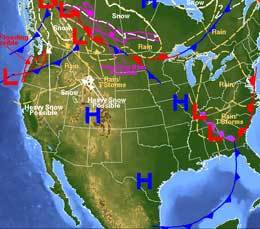 If weather forecasting hadn’t become so reliable and accurate over the years, we simply would not have the ability to plan and execute so many outdoor events with such a great amount of confidence.
This includes international sporting events, political rallies, and music concerts. Or it can simply be a fun day out with your family or partner. And for forecasts covering the next few days, the weather reacts as predicted most of the time.
The high accuracy with which meteorologists are able to predict weather events is a result of vastly improved technology, better forecast models, and access to historical weather data. It is this last factor that will be the focus of this article.
What Is Historical Weather Data?
Before we can go into the details of historical data and why it is so important, we need to understand exactly what it is.
Historical Weather Data Definition

Historical weather data is a record of past weather conditions in a particular region. This record includes multiple weather variables such as temperature, rainfall, wind direction and speed, humidity, and barometric pressure.
Historical weather data can be as recent as weather information from a week ago. However, it usually stretches back years, decades, and even centuries. The longer and the more detailed the record is, the more valuable it is to the meteorologist.
In the field of meteorology, this historical weather data is crucial not just for understanding current weather conditions but also to assist with the prediction of future weather conditions and events (weather forecasts).
But for those of us with our own personal weather stations, gathering historical data is just as important to help us understand and forecast the weather in our specific region. (More on that a little later.)
To best understand its true value, we need to understand how meteorologists go about calculating and predicting weather conditions.
How Meteorologists Predict The Weather
Climatologists and meteorologists use a combination of data, advanced computing power, and complex forecast models to calculate and make weather predictions.
It will make the most sense if we look at each of the individual forecasting steps on their own to understand the process as a whole.
Data Gathering
Meteorologists use a multitude of readings from sensors and devices around the planet to collect weather data. This includes sensors on the ground, in the ocean and air, and also in space, which provide the data needed to make important decisions and accurate forecasts.
Land-based radar systems, remote weather stations, ocean buoys, weather balloons, and satellites are just a few examples of sources that provide data which is captured and processed by weather services.
(There is quite a bit of confusion as to what exactly a weather balloon is and what role it plays in the gathering of meteorological data. You can get an in-depth explanation in this article.)
One of the most important sources of data, however, is the vast record of historical weather data used as a source of reference. Although modern forecasting models mainly use current observations to calculate future weather conditions, historical records help meteorologists test and improve these models and compare current conditions with similar weather events from the past.
Processing Through Raw Computing Power
Vast numbers of sensor readings and observation reports are gathered across the planet every day. Combined with the mountains of historical data, weather services need some serious computing power to process this volume of information.
There is no way one single computer, no matter how powerful, can even begin to process even a fraction of this data.
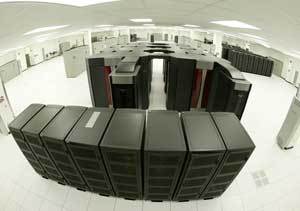
To give you an indication of the size and power needed to process all this data, the ECMWF (European Centre for Medium-Range Weather Forecasts) uses a powerful supercomputer system to store and process its data.
The current system consists of four large clusters containing more than one million processor cores. And it can process data at around 30 petaflops!
(A petaflop is the name given to a processing speed of one thousand million million floating-point operations per second.)
That is the amount of computing power needed to handle the sheer amount of data. And the ones we have today are still not powerful enough to entirely make use of the forecasting models meteorologists are currently using and constantly improving upon.
A large section of these supercomputers and data storage systems is dedicated to storing and processing historical weather data.
But how do these supercomputers even know how to handle all this data thrown at them?
Weather Forecasting Models
Numerical weather prediction (NWP) has been extensively used since the development of the computer during the last century, which made the processing of all gathered weather data possible.
These numerical forecast equations used to calculate weather and climate are called weather forecasting models.
There are numerous forecasting models for different types of weather events. Two global weather forecasting models are generally regarded as among the most accurate and trusted models used by meteorologists and climatologists.
-
- The ECMWF (European Centre for Medium-Range Weather Forecasts) uses what is more commonly known as the European Weather Forecasting Model.
- The GFS (Global Forecast System) is more commonly known as the American Weather Forecasting Model.
Both models are very accurate and highly regarded by the global meteorological society, but each one has its own unique weather forecasting methods.
The calculated results from these forecasting models form one of the final steps in the whole forecasting process. Meteorologists still need to analyse and interpret the results before producing the final forecast.
The Importance For Your Home Weather Station To Record And Store Weather Data
This brings us to the section where I really want to drive home a very important point to all home weather station owners.
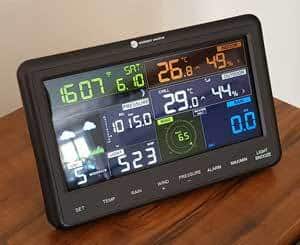 Make sure your home/personal weather station can record and store all the weather data its various sensors capture!
Throughout this article, I made it very clear why historical weather data is so important in not just observing and understanding current weather, but especially for predicting future weather conditions.
Just remember, the weather is unique in your area where your weather station is situated. Even if you have access to local and regional historical data, it is almost guaranteed that your home/neighborhood will have its own micro-climate.
In order for you to be able to make any kind of accurate weather prediction, you will need a historical record of conditions in your location. You need to know what the weather was like in the past under similar circumstances and how it reacted and changed.
This is why it is so crucial that you start to keep a record of your readings as soon as your weather station is up and running. And make offline backups of your weather records!
(Don’t make the mistake I made. I kept all records online until a chain of events caused me to lose all my connections. This resulted in me having to reset my router, my Ambient Weather station, and re-register as a new user with a new weather station.)
This little mishap caused me to lose the first four months of weather data. Now I am already four months behind with my historical data buildup.)
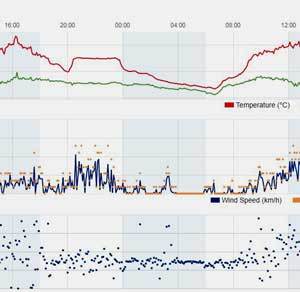 The vast majority of professional weather stations for home use come with WiFi connectivity built-in. They are also ready to be integrated into popular online services like Wunderground (Weather Underground).
Manufacturers like Ambient Weather created their own online service, which lets your console connect to their network. This displays a personal dashboard on your device with real-time readings from your weather station.
It also keeps a database that records all your weather station’s readings and displays each weather variable on highly customizable graphs. (With the option to export all your data in a separate file, which I highly recommend.)
(If you are interested, you can read more about my experience with my Ambient Weather WS-2902A Osprey, especially the WiFi setup and integration in this article.)
This is just one example of how a fully connected and well-set-up weather station can make building up a historical weather record relatively painless. Most manufacturers have their own online systems that work just as well.
This is the reason why I am so critical of high-end weather stations that don’t offer these features. (Or sell them as optional extras.) They can really do better.
My advice to you is simple. I urge you to invest in a weather station that can record and build up a database of historical weather data, and use it! (And remember to make offline backups.)
Conclusion
I don’t think there is too much to summarize, as I have made my point over and over throughout this article.
By now, you should not be under any illusion as to how important a database of historical weather data is for accurate forecasting. The same applies to choosing a personal weather station that enables you to build such a database.
I hope you found this article helpful and that it reminded you to pay attention to an often overlooked but essential part of meteorology.
Until next time, keep your eye on the weather!