

Arctic Regions Are Literally Burning And Melting Away – What This Means For Rising Sea Levels
Arctic Regions Are Literally Burning And Melting Away – What This Means For Rising Sea Levels
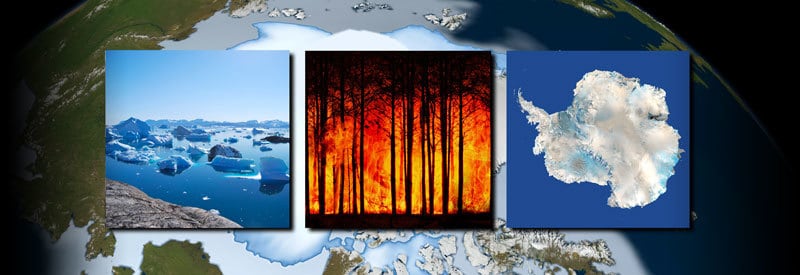
Most readers will find it very hard to imagine wildfires occurring in regions in the Arctic Circle. However, this is precisely what has been happening in places like Greenland and Siberia in recent years.
In recent years, these regions experienced some extreme weather events, and it seems like it might be the start of a trend that will only persist and get worse.
At the time of the original writing of this article, record high temperatures were recorded across Europe as heatwaves struck during July 2019. (Read more about this phenomenon in this article.) More recently, the Arctic recorded its second-warmest year on record in 2024, which further emphasized the growing problem.
The resulting dry conditions created a favorable environment for a further escalation to occur, which is precisely what happened, as you will find out later in the article.
In this article, we will examine how the extreme weather that hit the Northern Hemisphere during July 2019 resulted in the extraordinary occurrences of wildfires. We also look at the resulting large-scale melting of ice on Greenland’s ice sheet.
We also look at the impact these two occurrences have on the rate at which the Arctic is melting. We finally have to conclude whether we are looking at an anomaly or a new accelerated trend.
Unprecedented Events Highlighting The Accelerated Warming Of The Arctic Regions
1) Wildfires in Alaska, Greenland, and Siberia
The scorching hot temperatures that the Northern Hemisphere experienced during July 2019 resulted in wildfires occurring in areas where you would never think possible.
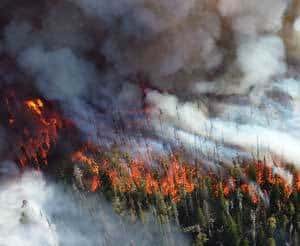
Satellite images were among the first to pick up the traces of smoke and eventually revealed the real extent of the wildfires that were burning out of control in large areas of Alaska, Siberia, and even Greenland.
The record high temperatures allowed areas that would usually be covered with snow to dry out and, assisted by the warm weather, create favorable conditions for fires to start.
These conditions resulted in a combination of wildfires on a scale not seen before in these regions:
-
-
- Alaska was battling more than 100 fires, which had already burned about 2.6 million acres of land in 2019.
- In Siberia, Russia, fires destroyed more than 6.4 million acres of land by the end of July 2019.
- Greenland also experienced wildfires during July. (Although the rapid melting of its ice sheet is a much bigger problem.)
-
On their own, these fires already have a significant effect on the local environment. When combined, though, these fires severely affect the entire Arctic Region.
-
-
- It accelerates the rate at which the ice is melting (which is already taking place at an alarming rate).
- Satellite imagery also shows smoke covering large parts of the Arctic. It not only causes pollution on a large scale, but the amount of carbon dioxide released into the atmosphere further contributes to rising temperatures.
-
It is clear to see how widespread fires in the Arctic only contribute to an already dire and alarming situation in the region.
2) Melting Of The Greenland Ice Sheet And The Polar Ice Caps
It is still surprising to hear people continue to ask, “Is the Arctic melting?” It has already been overwhelmingly demonstrated by observations and scientific studies throughout the last couple of decades.
Also, the growing number of extreme events widely reported in the media, including large-scale flooding and receding coastlines, helped to reinforce this fact. Not to mention the increasingly deteriorating weather conditions that we are all experiencing globally.
Greenland
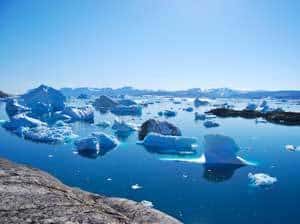
The rapid melting of the ice sheet in Greenland can be seen as the single most crucial piece of evidence to illustrate the alarming rate at which the Arctic Region is melting.
Following the hottest July ever recorded, Greenland lost 11 billion tons of surface ice as it melted away into the ocean on 1 August 2019. To put it in context, this amount of water is enough to fill approximately 4.4 million Olympic-sized swimming pools. And this was just one day!
If you take into consideration the fact that about 80 percent of Greenland is covered by ice, which is enough to raise global sea levels by about 7.4 meters (24 feet) if it all melts, you don’t need to be a mathematician to realize the severe consequences of this continuing trend.
Polar Ice Caps
The majority of the world’s ice is concentrated in the polar regions at both the North and South Poles. Antarctica alone contains about 90 percent of the world’s ice.
The alarming reality is that NASA is estimating that the ice caps are melting at a rate of 9 percent every ten years. It means if the current rate at which the planet continues to warm up continues, so will the rate at which the polar ice is melting increase.
If this is not enough to cause you to start to get more than a little concerned, you might want to consider the following.
-
- The sea level will rise by 61 meters (200 feet) if all the ice in Antarctica melts.
- The Arctic could be left seasonally ice-free in summer before mid-century if the temperature on the planet continues to rise at the current rate.
- If enough ice melts to allow sea levels to rise by more than 1.83 meters (6 feet), many major coastal cities in the world will face severe flooding and growing long-term risk.
Although none of the above-mentioned scenarios is predicted in our lifetime, it does not make it any less of a reality. After all, according to climate models, the amount of ice that melted in Greenland during that week in August was not expected until around 2070 under worst-case projections.
One of the primary reasons temperatures in the Arctic are rising at such an increased rate compared to the rest of the planet is due to a phenomenon called Arctic Amplification:
Arctic Amplification Definition
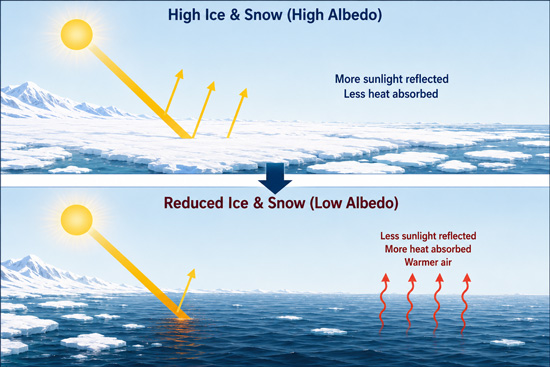
The melting of snow cover and sea ice is mainly responsible for the accelerated warming of air temperatures in the polar regions. The white snow and ice usually reflect the majority of the heat from the sun. The darker waters of the ocean in contrast, absorb and retain the heat.
With less ice and snow present, more heat gets absorbed and retained by the exposed ocean water. The resulting warmer air, combined with global warming, leads to this accelerated rise in temperature, which is known as Arctic Amplification.
Consequences Of The Melting Of The Polar Ice Caps
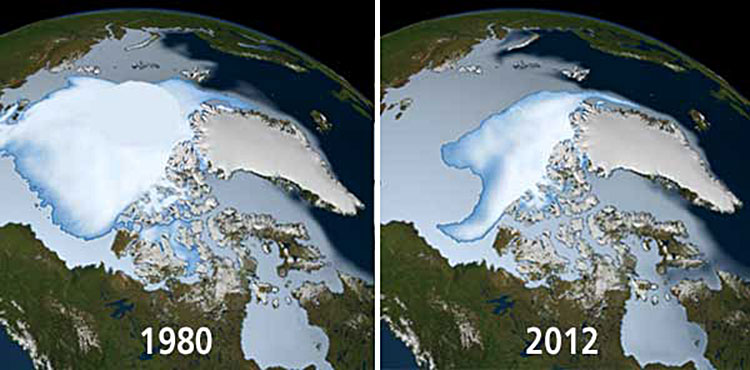
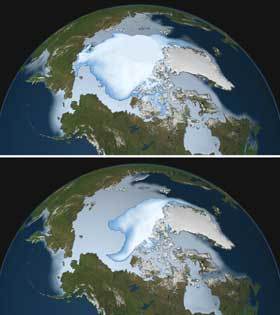
NASA images captured in 1980 and 2012 show how much the polar ice caps have declined.
As already mentioned, the polar ice caps are already melting at an alarming rate of 9 percent every ten years.
If the acceleration of ice melting on the Greenland ice sheet, as well as the widespread wildfires, is pointing towards a new trend and not a once-off phenomenon, we are looking at two serious consequences:
1) Rising Sea Levels
Yes, sea levels are already rising at an alarming rate. Whether you are a climate change skeptic or a Greenpeace environmentalist is beside the point. Rising sea levels have been taking place at an accelerated pace for at least a century now.
This trend shows no signs of slowing down. On the contrary, temperatures continue to rise. If the wildfires and rapid melting of the Greenland ice sheet also become the “new normal,” the compounding effect will cause sea levels to rise even faster.
At the very least, current forecasts calculating rising sea levels may need to be revised. Current climate forecasting models may also have to be adjusted to compensate for new variables
2) Global Temperature Rise
The cold climate of the Polar Regions keeps the rest of the world cool through global wind movement, as well as cold air masses moving towards the Equator.
As a result, if the events of 2019 indicate the beginning of a new trend, the rate at which the Arctic warms up will also cause global temperatures to rise even faster.
If the Arctic, which keeps the planet’s temperature balanced, keeps on diminishing at an accelerated pace, it will be hard to see temperatures able to stabilize any time soon.
We may also be looking at a snowball effect where increasing temperatures from the Equator and the Arctic, feeding each other, result in global temperature rise at an unprecedented rate.
Conclusion
Throughout this article, a pretty grim picture of the planet’s future has been painted. If you take it too literally, you will be forgiven for concluding that the fate of our climate is sealed, and we are headed for imminent doom.
That is not the intention of this article at all. This post aims to bring the extreme and unusual events of the summer of 2019 in the Arctic Region to your attention. As mentioned, it may just be an anomaly, but all indicators point towards a growing trend.
If this is the case, our global society as a whole needs to realize the increased threat. We need to double our efforts to do everything in our power to slow and eventually stop the process. Yes, the damage may be done, but it is never too late.
Until next time, keep your eye on the weather!