

Nacreous Clouds Explained – What They Are And How They Develop
Nacreous Clouds Explained – What They Are And How They Develop
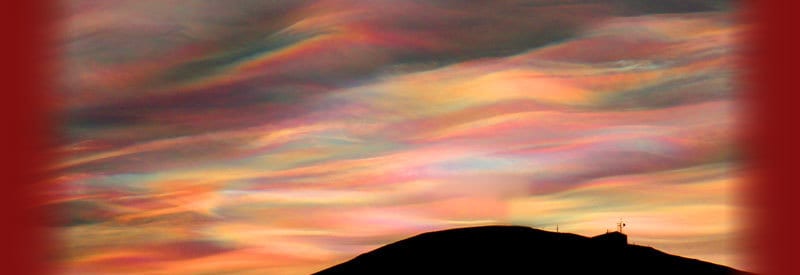
An observer once commented, “Once seen, they are never forgotten.” He was referring to a rare weather phenomenon called Nacreous Clouds, which occasionally forms in the skies above the Arctic.
This phenomenon is also known as mother-of-pearl clouds, a sporadic cloud formation that appears in regions within and bordering the Arctic Circle. These clouds are more commonly known as nacreous clouds.
What makes nacreous clouds so unique is not only their rare occurrence but also the wide array of colors they display, which gives them a uniquely surreal appearance.
(The reason for the “mother of pearl” association and resulting name will be explained in more detail later in this article.)
For the remainder of this article, the name “nacreous clouds” will be used to describe this phenomenon. Wherever necessary, though, the term “mother of pearl clouds” will be brought into the discussion to explain the association or draw a correlation.
In this article, we will focus on what nacreous clouds are, how they form, and what their characteristics are.
What are Nacreous Clouds?
From the introduction alone, it has become crystal clear that a nacreous cloud occurrence is a very unique and awe-inspiring phenomenon. It begs the question as to what they are and how they form.
Before looking at their origin and formation, one first needs to establish a clear and concise definition of what nacreous clouds are:
Nacreous Cloud Definition
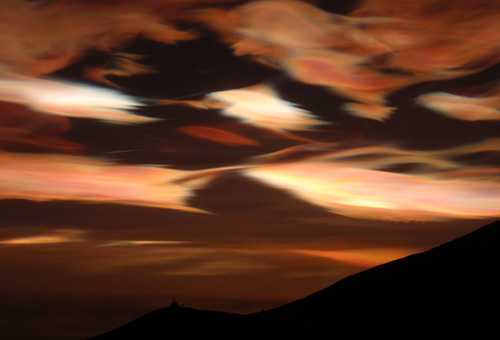
Nacreous clouds, also known as mother-of-pearl clouds, are polar stratospheric clouds that occur high in the stratosphere moments after sunset in regions close to or in the Arctic Circle. This rare meteorological phenomenon, mostly limited to polar regions, is identified by its unique display of iridescent colors and patterns.
Nacreous clouds are high-level clouds that occur in the stratosphere over polar regions at heights of 15 000 – 25 000 meters (49 000 – 82 000 ft). They are officially known as polar stratospheric clouds.
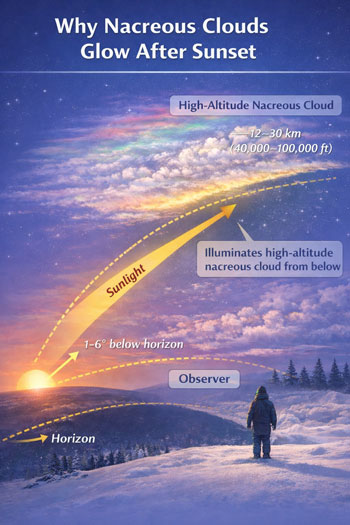
This phenomenon can be best observed within the first two hours after sunset when rays of light illuminate the clouds from below the horizon. The iridescent colors are caused by ice crystals scattering and refracting the light as it reaches the cloud.
Iridescence is an optical occurrence that causes objects to display vivid rainbow-like colors. In the case of nacreous clouds, the colors can vary from luminous and vivid to the familiar pastel colors that are so unique and contribute to the surreal effect of this phenomenon.
Why Are They Called Mother-Of-Pearl Clouds?
The word “nacreous” in nacreous clouds is derived from the word “nacre.” Nacre is the substance responsible for the iridescent rainbow and pastel colors known as “mother of pearl” found in certain mollusk shells.
In jewelry, a pearl starts forming in a mollusk shell as nacre starts building up around a small particle, like a grain of sand. As the pearl grows, the inside of the shell also gets covered with nacre.
The unique iridescent colors of the inner shell covered with this substance closely resemble nacreous clouds. Hence, the subsequent naming of the meteorological phenomenon as “mother of pearl clouds.”
This section gave a clear explanation of what nacreous clouds are, their characteristics, and why they display their unique “mother of pearl” colors. The focus should now shift to how these cloud phenomena form, which we will address in the next section.
How Nacreous Clouds Form
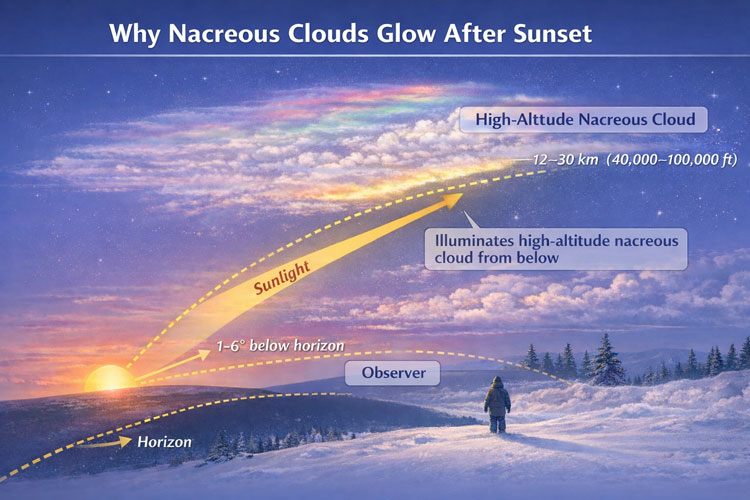
 As previously stated in the definition, nacreous clouds form at high altitudes, approximately 15 000 – 25 000 meters (49 000 – 82 000 ft) above the surface in the lower stratosphere. It is these high altitudes that allow them to remain illuminated for some period after sunset.
The clouds also need to be illuminated from below for iridescence to occur, which means mother-of-pearl clouds can only be observed after sunset when the sun is between 1 – 6 degrees below the horizon.
Nacreous clouds also form under very low temperatures. The clouds can only form once the air temperature drops below -78° Celsius. It is also one of the reasons why the phenomenon is mostly observed in Arctic regions, which experience these low temperatures.
The air over the polar regions is normally very dry, making cloud formation a very rare occurrence. When clouds do form at high altitudes above the surface, the ice crystals in nacreous clouds are much smaller than those that form in normal cloud formations.
It is these smaller ice crystals that allow sunlight to be scattered and refracted in such a way that it produces the vibrant iridescent colors unique to this phenomenon.
During the day, nacreous clouds may resemble pale cirrus clouds that are almost unnoticeable. Once the sun dips below the horizon, however, the clouds start to display bright luminous colors.
As the sun continues to sink further below the horizon, the bright luminous clouds slowly change into a mixture of pink, green, and mostly pastel-colored formations, which contributes to the surreal effect that is so unique to nacreous clouds.
Unlike most other fast-moving cloud formations that occur much lower in the atmosphere, the aptly named mother-of-pearl clouds also seem to remain stationary in the sky as a result of their great height.
Best Time & Conditions To See Nacreous Clouds
Nacreous clouds can only be observed under very specific conditions, which is one of the main reasons why they are so rarely observed.
The best time to observe these cloud formations is shortly after sunset or just before sunrise, when the sun is positioned between 1 and 6 degrees below the horizon. At this angle, sunlight can still reach the high-altitude clouds from below, causing them to display their distinctive iridescent colors.
They are most commonly seen in regions close to the Arctic Circle, where the extremely low temperatures required for their formation are more likely to occur. On very rare occasions, they have also been observed over parts of Northern Europe and even further south under exceptional conditions. These are exceptions to the rule, though.
Clear skies are essential for observing nacreous clouds, since lower-level cloud cover can easily obscure them. The combination of very cold temperatures, high altitude, and the correct solar angle makes the conditions for their appearance quite rare.
Conclusion
Nacreous (or mother-of-pearl) clouds are rare occurrences that appear almost exclusively over the Arctic regions and are seen by very few people in selected areas as a result.
Yet, their appearance and surreal color displays are so unique and captivating that they are better known than their rarity suggests, especially in meteorological circles.
This article examined and explained what nacreous clouds are, their characteristics, and how they are formed. It also explained why they are called mother-of-pearl clouds and the connection between the two.
Until next time, keep your eye on the weather!